

The FEnIKS funding call for sustainable rainwater management systems is now open. With a budget of PLN 400 million, applications can be submitted from 15 October 2026 to 30 January 2027. For eligible cities, this is an opportunity to fund water retention and green-blue infrastructure projects. Preparations should begin with reviewing the funding conditions and identifying the environmental and water-law documentation required for the planned works.
FEnIKS Funding for Rainwater Management — Key Information
Call FENX.01.02-IW.01-001/26 No. FENX.01.02-IW.01-001/26 is administered by Poland’s National Fund for Environmental Protection and Water Management (NFOŚiGW). It supports sustainable rainwater management systems incorporating greenery, green-blue infrastructure and nature-based solutions.
Key funding conditions:
- Budget: Budget: PLN 400 million.
- Application period: from 15 October 2026 to 30 January 2027, until 3:30 p.m. Polish time.
- Maximum funding rate: 77% of eligible project expenditure.
- Minimum grant amount: PLN 1 million.
- Submission method: electronically through the WOD2021 application.
The minimum grant amount is different from the minimum total project value. Budget planning must account for the applicant’s own contribution and any ineligible expenditure.
Who Can Apply for Funding?
This call has a restricted scope. According to the announcement, it is available only to cities that participated in the project “Developing Climate Change Adaptation Plans for Cities with More Than 100,000 Inhabitants” and to the City of Warsaw.
Eligible applicants include:
- local government units;
- organisational units acting on behalf of local government units;
- entities providing public services as part of local government units’ own statutory responsibilities.
Being a municipal company or carrying out a project within a city does not, by itself, establish eligibility. Before starting preparations, both the applicant’s eligibility and the project’s compliance with the funding conditions should be verified.
What Types of Projects Can Receive Support?
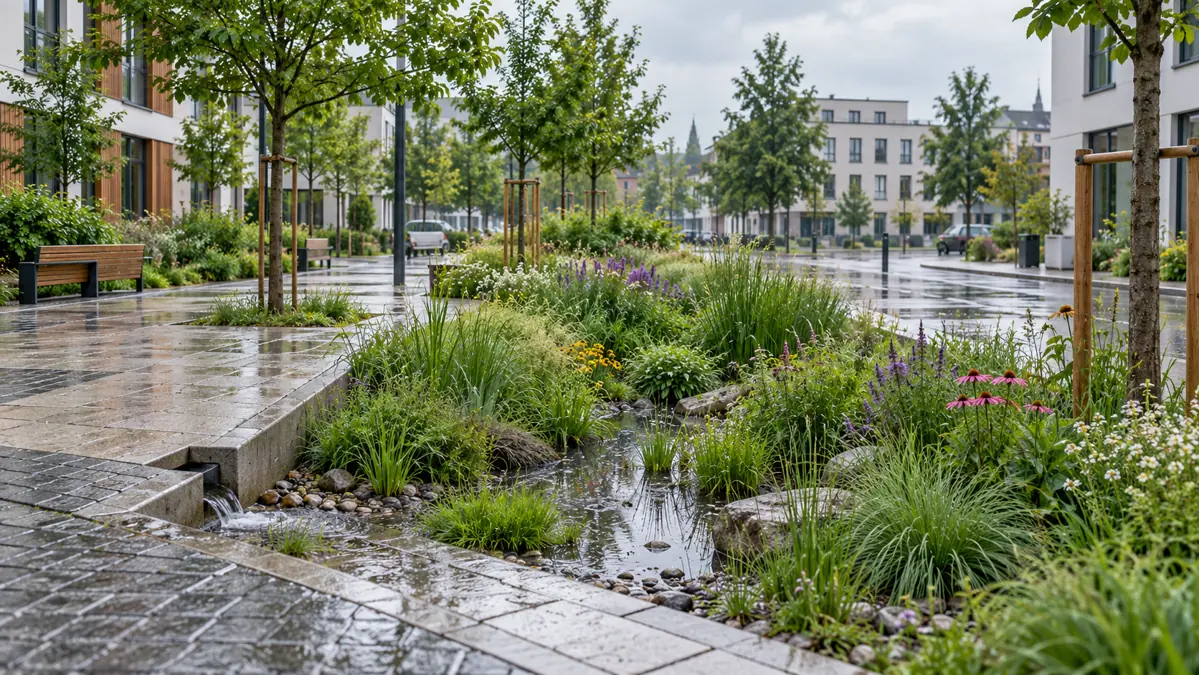
The call covers sustainable rainwater management solutions that use greenery and natural processes. Examples identified by NFOŚiGW include rain gardens, green roofs and green spaces that retain water.
The project’s connection with the city’s climate change adaptation plan is also important. When preparing an application, applicants should explain which problem the project addresses and how it contributes to the city’s adaptation measures.
It should not be assumed that every storage tank, stormwater drainage section or green space automatically qualifies for funding. The project as a whole is assessed against the call’s rules and selection criteria.
Where Should Documentation Preparation Begin?
The first step is to organise the available project information. At this stage, it is useful to establish:
- the project’s location and boundaries;
- the catchment area and its characteristics;
- the existing rainwater management arrangements;
- the planned retention measures and arrangements for discharging excess water;
- the scope of construction, alteration or removal of existing structures;
- connections with other infrastructure;
- existing decisions, permits and technical documentation.
This information helps identify the studies and documents required and the order in which they should be prepared. It also helps establish whether the documents cover the same project scope.
Does the Project Require an Environmental Decision and a Project Information Sheet?
Not every water retention or rainwater management project requires a decision on environmental conditions.
The requirement depends on the project’s classification under Polish legislation governing projects likely to have significant environmental effects. The assessment considers the actual scope and parameters of the project and its connections with other project components.
For projects classified as potentially having significant environmental effects, a Project Information Sheet — known in Poland as KIP — is generally used in the procedure. Based on the information collected, the competent authority determines whether an environmental impact assessment and an environmental impact assessment report are required. karta informacyjna przedsięwzięcia — KIP. Na podstawie zebranych informacji właściwy organ rozstrzyga, czy konieczne jest przeprowadzenie oceny oddziaływania na środowisko i sporządzenie raportu.
A KIP is therefore not automatically required for every project funded through FEnIKS. The project must first be classified correctly.
When Is Water-Law Documentation Required?
Water-law requirements depend primarily on the technical solution selected and how water will be managed.
A sealed rainwater storage tank requires a different assessment from an infiltration facility or a system involving discharge into a receiving water body and construction of an outfall.
Depending on the project scope, it is necessary to establish whether the following are required:
- a water-law permit;
- a water-law notification;
- a water-law report (operat wodnoprawny) supporting a permit application;
- consideration or amendment of existing water-law authorisations.
Describing a structure as a “retention tank” is not sufficient to determine the applicable obligations. Its construction, function, inflows, overflows and connections with the ground, water bodies and other infrastructure all matter.
For example, the Polish Waters authority states that a sealed rainwater storage tank is not a water facility under Polish Water Law and does not require a water-law permit for its construction. This does not automatically mean that other components of the overall system are free from such requirements.
Consistency Across the Documentation Matters
The project description in the funding application, design documentation and environmental studies should be consistent. Particular attention should be paid to:
- the location and scope of works;
- the parameters of tanks and other facilities;
- the catchment area;
- water management arrangements;
- the receiving water body and discharge conditions;
- the division of the project into phases.
Changes to the technical concept may affect the validity of earlier assessments and documents. Cooperation between the designer and the specialists preparing environmental and water-law documentation should therefore begin at the concept development stage.
The Application Deadline and the Schedule for Obtaining Approvals
The funding application deadline is not necessarily the deadline for completing all administrative procedures.
The documents required at submission and at subsequent stages must be identified from the rules and annexes for the specific call. Applicants should neither assume that all decisions must be obtained before submission nor that they can be supplied at any later date.
A practical approach is to prepare a schedule covering:
- Verification of eligibility for funding.
- Definition of the project scope and technical assumptions.
- Environmental classification and assessment of water-law requirements.
- Preparation of the required documents and submission of relevant applications.
- Coordination of the documentation with the funding requirements.
This schedule helps identify, at an early stage, factors that may affect project readiness.
How Can MASAD Support Project Preparation?
MASAD helps project developers identify and prepare the environmental and water-law documentation required for rainwater management projects.
The scope of our support may include:
- assessing whether a decision on environmental conditions is required;
- preparing a Project Information Sheet, where required;
- identifying the necessary water-law approvals;
- preparing a water-law report or documentation for a water-law notification;
- supporting administrative procedures within the agreed scope;
- working with the designer to maintain consistency across the documentation.
The scope of work is determined by the project’s characteristics and the materials available.
Planning a water retention or rainwater management project? Contact MASAD. Send us a project description, its location and your existing documentation. We will prepare a proposed scope of environmental and water-law services and a quotation.
Funding information is current as of 17 October 2026. Before submitting an application, check the latest documentation and announcements published by NFOŚiGW.
Sources
- NFOŚiGW — announcement of Call FENX.01.02-IW.01-001/26 (in Polish)
- NFOŚiGW — funding for urban rainwater management projects (in Polish)
- GDOŚ — environmental impact assessment system (in Polish)
- Polish Waters — frequently asked questions (in Polish)