


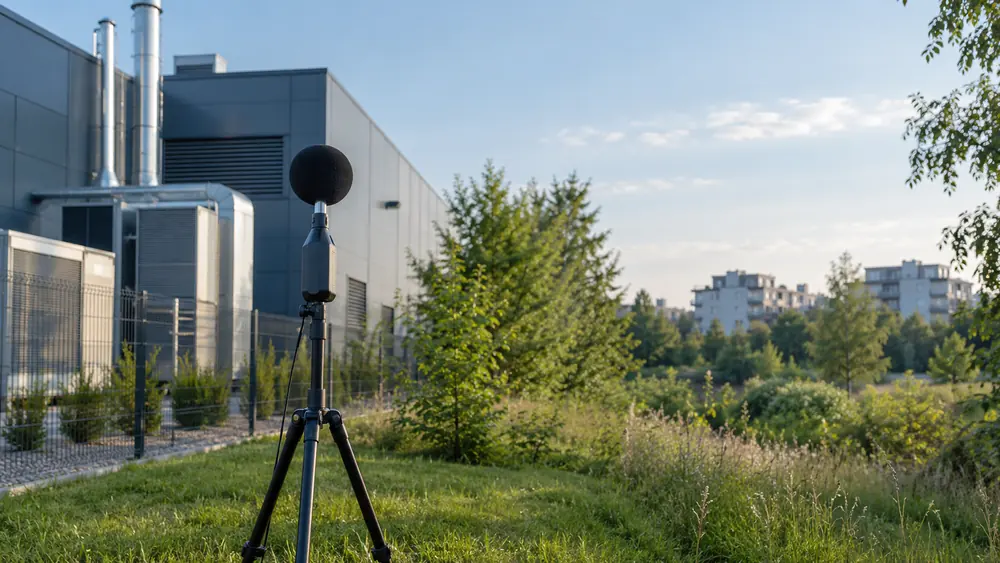
Environmental noise — assessment and measurements
Understand how your operations affect the surrounding area and plan effective noise mitigation.
We help businesses and developers assess noise from industrial sites, installations and proposed developments. We prepare acoustic assessments, noise propagation models and recommendations for reducing noise. We also coordinate measurements with laboratories and explain what the results mean for your operations.
When should you assess environmental noise?
An acoustic assessment supports decisions before construction begins and helps address noise issues at operational sites. You may need support when:
- planning the construction or expansion of an industrial, warehouse or commercial facility;
- installing fans, refrigeration units, heat pumps, compressors or other noise-emitting equipment;
- changing production processes, vehicle movements or operating hours;
- preparing documentation for an environmental decision or integrated permit in Poland;
- responding to complaints about noise;
- arranging measurements required by environmental obligations or permit conditions;
- comparing noise mitigation options before investing in their implementation.
Acoustic assessments and noise modelling
We assess how noise from a proposed or existing facility may affect neighbouring areas. Our assessments consider sound sources, operating conditions, building layouts and the surrounding environment.
Depending on the project, the scope may include:
- identifying noise sources and reviewing equipment specifications;
- identifying areas subject to noise protection requirements;
- modelling noise propagation for defined operating conditions;
- assessing daytime and night-time noise impacts;
- presenting results graphically, including noise contour maps;
- comparing equipment locations and mitigation options;
- providing conclusions and recommendations for design or operation.
We tailor the assessment to its purpose, the development stage and the available information.
Environmental noise measurements
We coordinate measurements to assess the actual noise impact of operating installations and equipment. We define the objectives, arrange the work and help interpret the results.
Measurements are carried out in cooperation with laboratories with the appropriate testing scope, including accreditation where required by the assignment or applicable regulations.
Before testing, we agree on site operating conditions, access to measurement locations and the information needed to evaluate the results. Afterwards, we explain whether the findings indicate a need for further action.
How can noise from a site or equipment be reduced?
We begin by identifying the sources that contribute most to noise in the surrounding area. This helps focus mitigation efforts where they can have the greatest effect.
Depending on the circumstances, we assess options such as:
- relocating or reorienting equipment;
- installing silencers, acoustic enclosures and noise barriers;
- selecting equipment with better acoustic performance;
- adjusting operating hours or installation settings;
- reorganising deliveries, loading activities and vehicle movements;
- implementing mitigation in stages and checking its effectiveness.
Our recommendations reflect the site’s technical and operational conditions.
How we Work?
1. Understanding your needs
We establish whether you need an assessment for a proposed development, measurements at an existing site or support with a noise issue.
2. Reviewing information and defining the scope
We review the location, documentation, equipment information and operating hours. We identify missing information and agree on the scope of work.
3. Assessment or measurement coordination
We prepare the acoustic assessment or coordinate laboratory measurements, depending on the purpose of the assignment.
4. Results and next steps
We provide the documentation, explain the findings and identify potential measures to reduce noise impacts.
What information is needed for a quotation?
Start by sending the site location and a brief description of your requirements. If available, please also provide:
- a site plan or map showing equipment locations;
- a list of noise sources and their technical specifications;
- operating hours for the site, equipment and transport activities;
- previous assessments or measurement reports;
- environmental decisions, permits or correspondence with the authorities.
If some documents are unavailable, we will explain which information is needed to carry out the work.
Frequently Asked Questions
What is the difference between an acoustic assessment and noise measurements?
An acoustic assessment calculates predicted noise impacts using information about sound sources and the surrounding area. It can therefore be prepared before a development is built. Measurements establish the noise levels occurring under specific conditions during testing. The two approaches can complement each other.
Does every industrial site need periodic noise measurements?
No. The obligation depends on the site’s legal circumstances, its activities and the requirements arising from applicable regulations and administrative decisions. We review the relevant requirements before defining the testing scope.
Can an assessment cover ventilation, air conditioning and heat pumps?
Yes. An assessment can cover a single unit or the combined impact of multiple sources, including fans, refrigeration units, heat pumps and process installations.
How much does an acoustic assessment or noise measurement cost?
The price depends on factors such as the number of sources, the size of the area, the number of modelling scenarios or measurement locations, the need for night-time testing and the documentation available. We provide a quotation after reviewing your requirements.
Need an acoustic assessment or environmental noise measurements?
Send us the site location, a description of your operations and the purpose of the assessment. We will define the scope of work and prepare a proposal.